Train 27995 - 'Le Mistral' - Heading for Lyon Perrache
06 May - Nevers to Le Creusot with 141R 1199
Le Creusot to Lyon Perrache with 241P 17 and 141R 1199
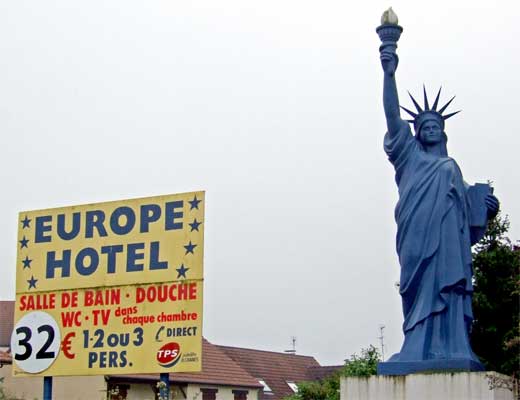
The day started with breakfast at Hotel Europe - this was a very basic affair consisting of a glass of orange, a croissant, a piece of baguette and jam and hot drink from the drinks machine. We had to be ready to be picked up by the coach at 08:00 so a fairly early start was had. Whilst waiting for the coach to turn up I wandered outside to find that, somewhat inexplicably, the hotel had a blue coloured and reduced in size version of the Statue of Liberty outside. Why?
|
Why? |
Train 27995 - 'Le Mistral' - Heading for Lyon Perrache |
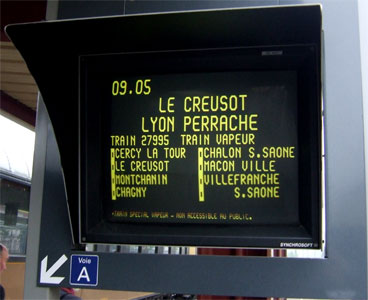
The coach journey back to Nevers Ville station took us over the route we were to take in the train which involved initially heading north out of Nevers before swinging east for Le Creusot. At the station No.1199, which had been turned, and the train were waiting on platform A for us when we arrived. I don't know if special arrangements had been made but the platform train destination screens were showing the details of our train!
The day had dawned overcast and a little chilly, however there was word that the forecast was good.
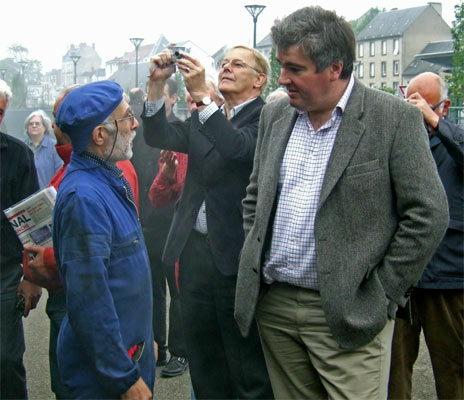 |
In France it would appear locomen will talk to anyone....... |
Departure from Nevers was on time. Now closer to the locomotive we could really start to hear what it was made of, especially on the initial climb out of the town and through a cutting lined with stone built retaining walls. The loco sounded fantastic! The standard of running on this very much secondary route was in line with that of the previous day, at least initially. Some way before out first booked stop the train slowed for what I assume was a long section of line with a speed restriction on it.
This audio clip, in MP3 format, is taken from a video soundtrack recorded on the train. 141R 1199 can be heard accelerating away from Nevers. (414KB)  |
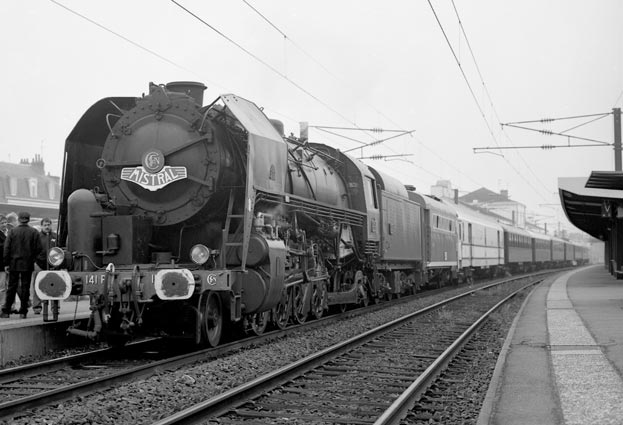 |
141R 1199 at a grey Nevers station. |
The first water stop was at the sleepy station of Cercy-la-Tour. As at Montargis the previous day no one seemed to worry about where we went around the station and yard to take photos in the greyness. Anyone who sampled the station toilets will be able to testify they are "very French", in other words smelly!
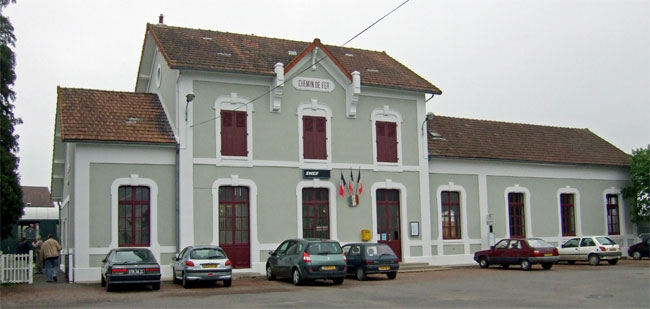 |
Despite being a rural station on a secondary line Cercy-la-Tour station is in good order. |
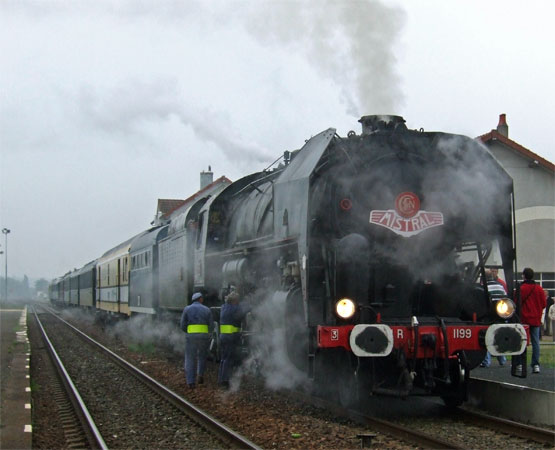 |
No.1199's support crew check around as the loco takes water at Cercy-la-Tour. Thankfully the weather was about to change for the better! |
After Cercy-la-Tour the speeds were back to what we were expecting over the undulating line which was generally increasing is altitude. For just under 20km from Étang the line was either climbing or level to the summit at Creusot tunnel. Étang was passed at walking pace, presumably due to a severe speed restriction on the river bridge just beyond the station but we were soon properly underway again. The final 3km of climbing from Étang are at 1 in 100. Whilst hardly a steep bank we certainly knew we were going up hill from the noise being produced. Speed had fallen back a little but the climb was an excellent one. By now the weather was starting to break with the final part of the climb being quite sunny.
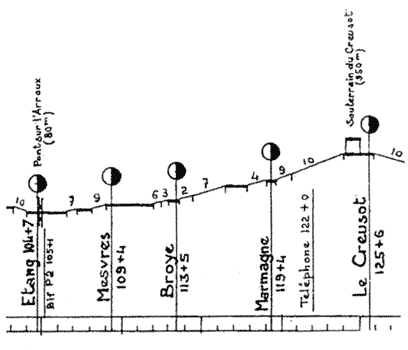 From the summit tunnel Le Creusot station is just under 1km further along the line. As we rolled into the station, to the right of the train, was 241P 17, being made ready for 'Le Mistral' duty. For brief details of the 241P click here.
To allow for shunting and servicing a three hour thirty minute break was booked here. Some opted to go into town for lunch whilst the majority of passengers joined the three trains on the Chemin de Fer du Creusot - a 60cm gauge railway associated with the the Parc Touristique des Combes. The trip on the line was an unexpected extra and one we didn't have to pay extra for. The costs were covered from what we had already paid for 'Le Mistral'. One train was steam hauled by the line's only operational steam locomotive, a 0-8-0t built by Henschel of Kassel, Germany. The other two were diesel hauled.
Having taken photos of the 141R shunting the tour stock places on the steam hauled train were taken so we had to ride up the line behind diesel and be content with steam haulage back down the hill. The line is built, in part, on the alignment of a former industrial line - the Chemin de Fer des Crouillottes. Originally 5.2km long it has recently been extended to 10km in length. It does what industrial narrow  gauge lines do best and winds its way uphill in a fairly spectacular manner. No reverses or spirals were employed but rather sharp curves leading to a 180° change of direction were not uncommon. At times three or four different levels could be seen from the train.
One of the trains was the line's dining train on which people who had booked could have a tray lunch either on the way out or on the way back. This train followed the steam departure, which went first, with the train we were on following last. The method of operation was described as being more or less line of sight train spacing. However for the uphill running the departures were spread apart in such a way that we never got close to the dining train. The first departure occurred at about 12:30, as booked.
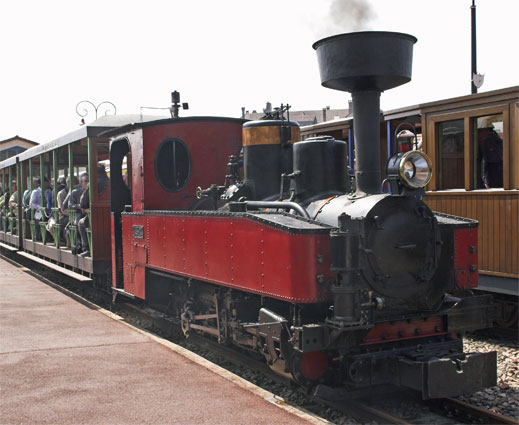
Henschel No.15526 at Le Creusot.
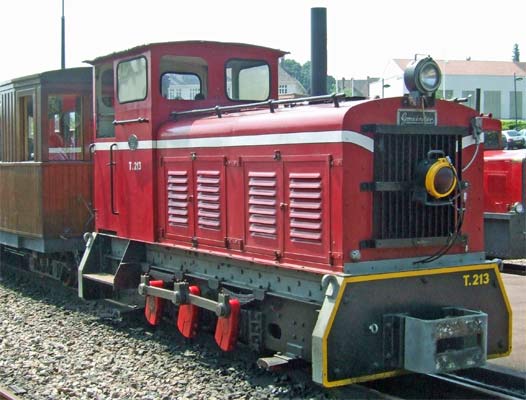
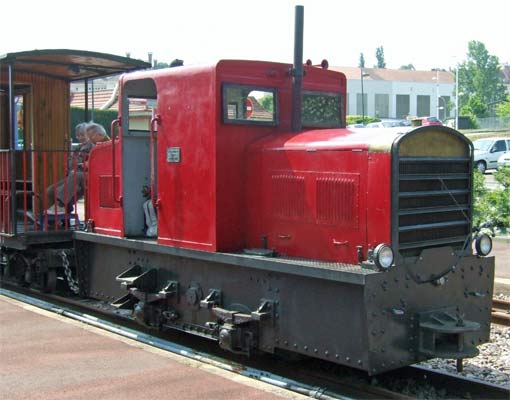
The two diesels used on our trip over the Chemin de Fer du Creusot.
Although diesel hauled the journey was excellent with great views across the town coupled to the impressive nature of the line's civil engineering.
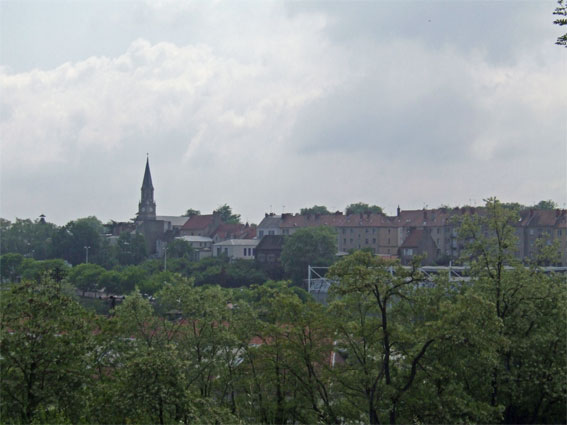 |
A view towards the centre of Le Creusot. The line had already gained considerable height by this time. |
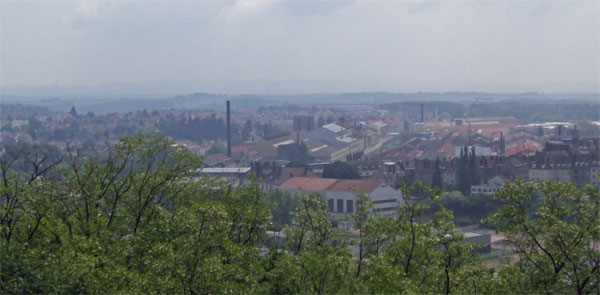 |
From higher up this view shows the industrial part of Le Creusot. The SNCF station is off to the left and lower down still. |
The summit of the line at Les Combes station, on a hill overlooking Le Creusot, is also the entrance to the amusement park complex which includes a small track for motor racing of some sort. The station has a small buffet which did good trade as it was after 1pm that the final train had arrived so, other than those on the dining train, everyone wanted lunch! As normal a selection of baguettes were available along with pancakes and waffles. Les Combes station also contains a souvenir shop with some railway related items.
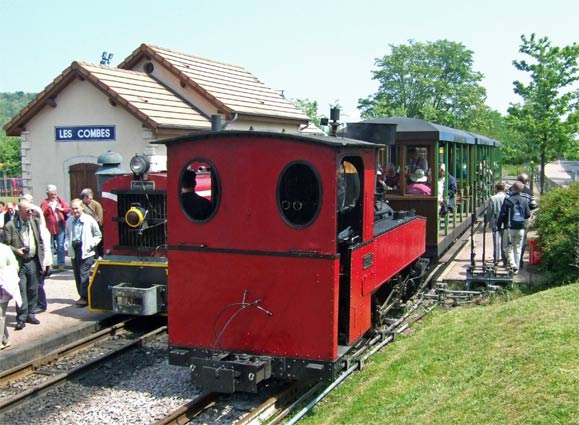 |
Les Combes station is the destination on the Chemin de Fer du Creusot. Here the Henschel 0-8-0t stands with its train alongside one of the diesels. The steam loco had been turned at Les Combes for the downhill run. |
Whilst not interested in what the amusement park had to offer the lunch break at Les Combe was very pleasant - the sun had come out and it was starting to warm up. The run back down the hill, again in three portions, was scheduled to start at 14:00 with 50 minutes allowed for the trip which turned out to be a little generous. The order of the trains downhill was the final diesel to arrive went first followed by the lunch train and finally the steam. The return route was, initially, different to the uphill and explained why levels we appeared not to have travelled on and a junction "facing the wrong way" had been encountered on the way up.
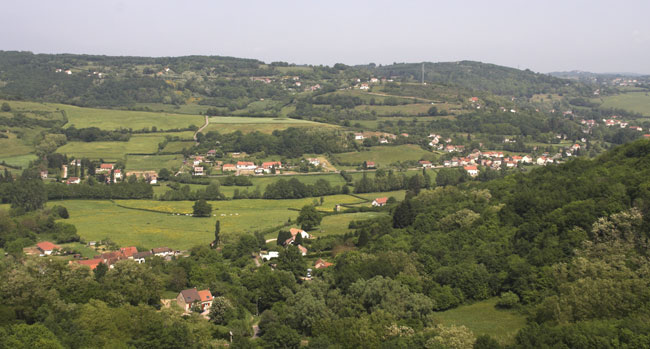 |
The line from Nevers is hidden by the trees in the foreground but is down in the valley just behind the closest house. The wooded hill to the right contains the summit tunnel. © Brian Bane |
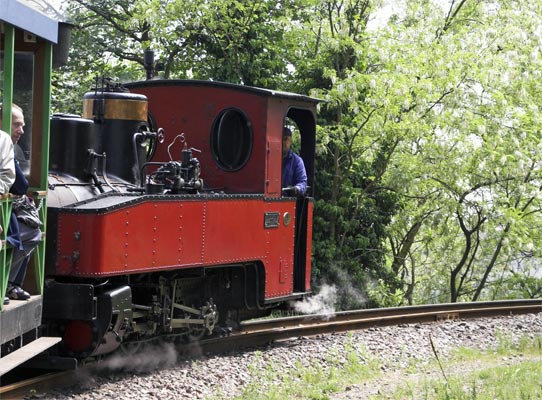 |
The Henschel heading downhill. © Brian Bane |
Setting off in the opposite direction to which we had come up the hill took us in the general direction of Nevers. It was possible to glimpse the line from Nevers which the 141R had brought us along after passing the line's depot and before some rusty wagons. Next came a tunnel which appeared to also be a paved road. Now back on the Le Creusot side of the hill we continued to loose height appreciably as other levels came into view. Finally the route down became clear - a sharp turn to the right, across a set of points, took us on to a bridge over one level we had come up. Then the train set back across the points to the junction "facing the wrong way" giving us access to the line we had traveled up. Reversing again, so with the engine leading, we were off down the route we had come up.
At the reverse point we had caught up both preceding trains despite there having been a good 5-10 minutes between departures. It was now that we started to run on "line of sight", seemingly not so unlike some Swiss rack lines. Being on the third train down the hill and with all three running quite close together we had to wait a little while outside of Le Creusot station whilst one of the diesels ran-round otherwise all the locos would have been trapped up against the stop blocks. Being held outside of the station presented us with a great view of the now strengthened mainline train with the very impressive combination of 141R 1199 and 241P 17 attached at the front with two carriages and a coal wagon for the 241P at the rear.
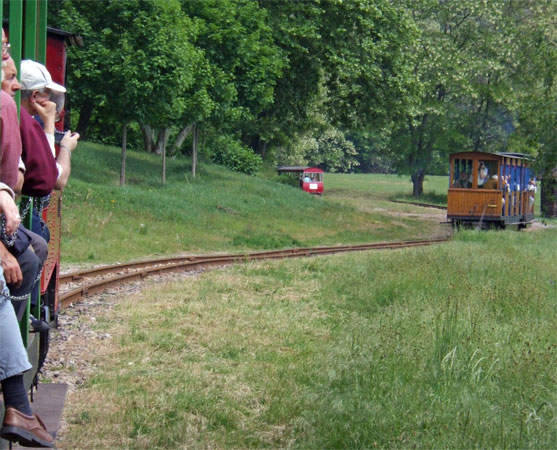 |
Line of sight running on the descent to Le Creusot. |
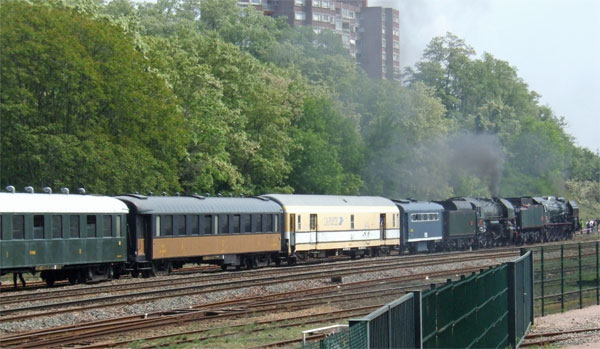 |
Waiting on the 60cm gauge line for a platform at Le Creusot this was our view. Over 6000hp! |
Having taken less than the timetabled 50 minutes to get down the hill there was plenty of time to take more photos of the mainline locos, look around the station shop, which had some different items to the one at Les Combes, and get an ice cream in the now quite warm afternoon. Departure Le Creusot was booked for 15:25 but we had been asked to be on the eastbound platform by 15:10. This was because once the train had pulled back into the station there would be no way of getting across from the westbound platform where the main buildings and access to the narrow gauge line are. As with many French stations there is only a board crossing between the two platforms, no footbridge or underpass. It would seem in France that people are trusted to have enough common sense to cross running lines in safety.
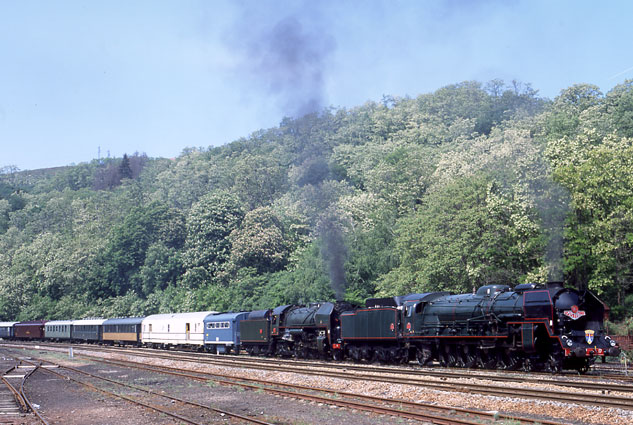 |
The photo doesn't quite seem to convey the impressive spectacle that the 241P, 141R and train made standing in the sidings at Le Creusot. |
Departure, double headed, from Le Creusot, were a lot of people had turned out to see us off, was about right time and was followed by fairly swift acceleration up to our new top speed of 80kph. This limit has been applied to the 241P by the operating group for the first year of mainline service. It was to cause us headaches later on the trip.
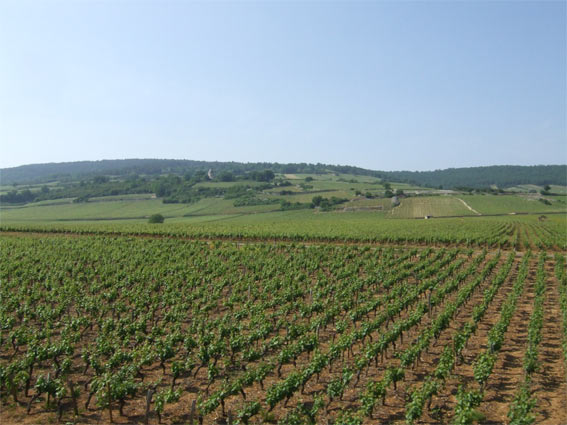 |
A typical view from the train between Le Creusot and Chagny - Burgundy country. |
Speaking as someone involved with mainline steam in the UK, slapping such a speed restriction on the loco doesn't seem to make sense. Either it is fit for mainline operation or it is not. In today's railway world were steam is not always welcome it ought to be incumbent on loco operators to do everything in their power to fit in with modern operations. The SNCF overall limit of 100kph is bad  enough for pathing but 80kph is much worse. It cost us many hours each day either just because of slower running or in extra pathing stops. It is to be hoped that in the future the limit on the loco is lifted to 100kph (120kph would be more sensible in the 21st century!).
The extra carriages added at the back of the train and the coal wagon, with grab, belonging to the 241P people brought the trailing load up to around 580t, a decent load for either engine but easy for the pair. With the 80kph limit now in place and being strictly adhered to, as the regular braking indicated, no high outputs or exciting running was going to be had on the trip to Lyon Perrache.
The first stop out of Le Creusot was only 8km away at Montchanin, a pick up point for French passengers. The 241P group had advertised the trip locally, one of the carriages attached at Le Creusot was for their passengers. From here we passed under the TGV route to the south of France whilst running through some lovely countryside. The regulation 80kph was kept up most of the way to Chagny where the train rejoined the PLM mainline, le ligne imperiale, to Lyon Perrache. A photo stop was booked here. Thankfully not too many locals had turned out so photos were possible - unlike at some stations later on in the tour!
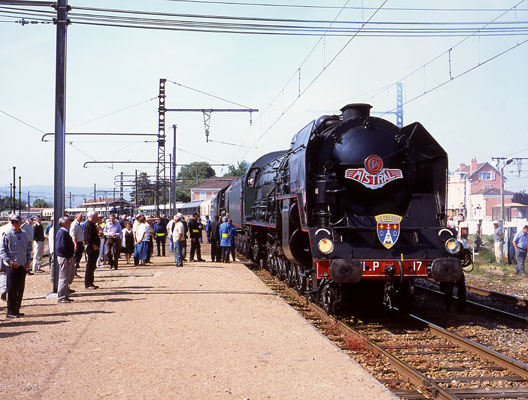 |
A short photostop was held at Chagny, junction between the PLM mainline and the secondary route from Nevers. |
Along the PLM mainline speed remained at or near 80kph all the way to the water stop at Chalon-sur-Saône. A lengthy stop was booked as both locos had to be watered. Chalon was one of the places a huge number of people had turned out to see the special and they had plenty of time to look - arrival was at 16:34 with departure set for 17:39. It also gave us the first chance to have a really good close-up look at the 241P. It's certainly a very different beat to the heavy-duty construction of the 141R.
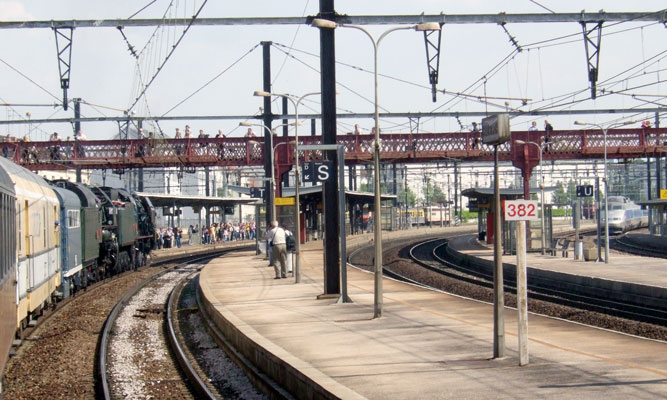 |
'Le Mistral' rolls into Chalon-sur-Soane as a TGV arrives from the south. |
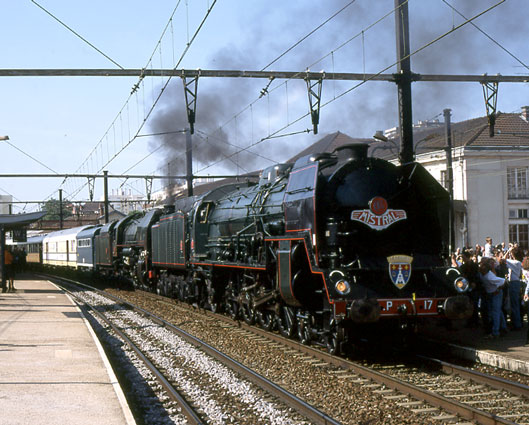 |
241P 17 and 141R 1199 take water at Chalon-sur-Saône. |
Arrival time in Lyon was booked for 20:22, with SNCF playing ball it looked like something approaching a right time arrival was on the cards but then it all went wrong! Somewhere to the north of Mâcon, our next booked stop, we sighted red signals and after rolling up to them very slowly before coming to a stand. The inspector, chef du traction in French, got down and phoned the signalbox. When he returned to the loco a lot of people started to get down and could be seen feeling bearings. We had set off a hot box detector. We stood for what seemed like ages until, finally, we got underway again. However under SNCF rules we had to proceed at caution to Mâcon for a more thorough examination. So more time was lost. On arrival at Mâcon, where another huge crowd of locals was patiently waiting, further inspections were carried out and thankfully showed nothing to be amiss. As is so often the case hot box detectors and steam engines don't seem to mix.
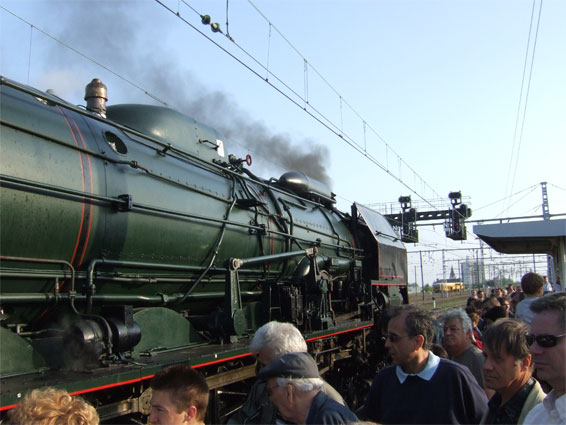 |
Mâcon - running late following the stop for a hot box detector so we were not sure how long we would be here. It appeared that half the town had turned out to see the train. |
On from Mâcon the running continued as before but with more sound from the front. Up to this point things had been virtually silent apart from lots of whistling. It now appeared that the 141R was doing more work as we headed towards Lyon Perrache. Having passed Lyon Vaise depot the train entered the 2109m long Saint Irénée tunnel which leads to Lyon Perrache station throat. It is not unusual for southbound trains to be held just inside the southern portal of the tunnel awaiting a platform. Fortunately 'Le Mistral' was allowed to run in without a stop!
In the end arrival here was not actually too late being around half an hour down. After 12 hours or so of  being on the move we quickly headed out to our hotels which were within 5-10 minutes walk of the station. The seven of us traveling together agreed to meet at about a quarter to ten to find some diner as we were all in need of it! We were directed to Brasserie Georges which, conveniently was only 5 minutes away. This art deco brasserie comes highly recommended - the setting was excellent as was the food and service.
So a very successful second day ended and with an early start booked for the next day a few hours of sleep was grabbed in readiness for the trip to Marseille.