7.
Application of proportional mechanical lubrication to cylinders
and valves. Click on the image to see an annotated photograph (99kb.)
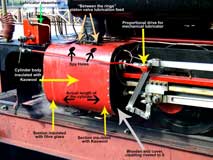
FCAF No.3 'Camila'
Work during stage 1 includes:
1.
Replacement of all 3 driving axles to correct design, attention was brought
to this matter following an in service failure of the main driving axle on March
7th 1999.
2. Replacement of all motion bushes due to wear in service.
3. Replacement of valve gear pins and bushes as for 2.
4. Alterations to the combustion system inclusive of new burner,
altered primary free air intake, fitting of stainless steel arch so as to form
a combustion chamber. Present arrangements of the combustion system are poor
to say the least. Application of superheated steam for atomisation.
5. Alterations to cab interior (layout of cab controls) in
order to raise ergonomic efficiency.
6. Returning of main driving wheel tyres to restore profile
and inclusive of high adhesion profile rather than standard profile.
7.
Application of proportional mechanical lubrication to cylinders
and valves. Click on the image to see an annotated photograph (99kb.) |
|
8.
Improved boiler insulation.
9. Repairs to boiler flue tubes in order to prevent leakage
at firebox tubeplate.
10. Redesign and manufacture of sanding gear.
11. Steam operated flange lubricator – design and manufacture.
12. Alterations to the steam circuit so as to improve the breathing
capacity of the locomotive.
13. Overhaul of all boiler fittings.
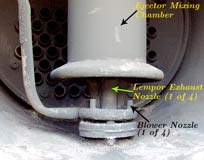
14.
Design and manufacture of new exhaust system to Lempor type, this to include
Kordina, exhaust manifold, mixing chamber and chimney. Present draughting
arrangements are very poor and (apart from the design and manufacture
faults associated with the main driving axles) constitute the worse area
of this locomotive. Click on the image to see an annotated photograph
(87kb.) |
 |
15.
Renewal of piston and valve rings.
16. Redesign of bogie side control gear, manufacture and fitting
of new components to corrected design.
17. Full overhaul of air pump, the type fitted to this locomotive
have been notorious for failing in traffic. The company is looking into the
possibilities of an improved design of air pump that will stand up to everyday
service, the present Winson design unfortunately does not.
18. Air pump exhaust to be moved so as to discharge at a point
outside the smokebox i.e. this in turn does not have a bad influence on the
draughting of the locomotive as is often the case with British locomotives that
have vacuum exhausts and air pump exhausts piped so as to expel through the
chimney!
A Brief History of the Lynton and Barnstaple outline, 500 mm gauge, 2–6–2T Locomotive - Camila
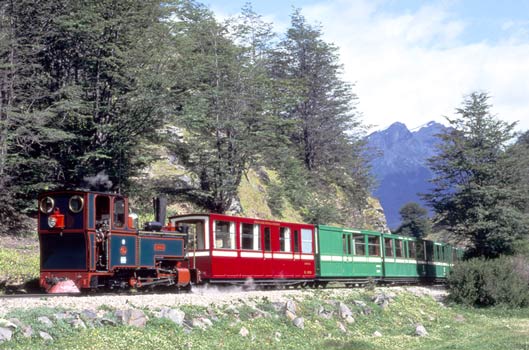 |
FCAF
No.3 'Camila' hauls a return working near Estación del Fin del
Mundo. January 18 2004 |
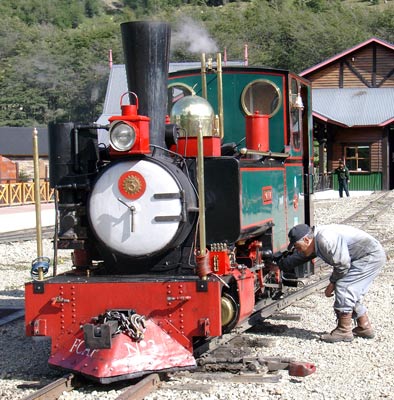 |
FCAF
No.3 'Camila' at the end of a days work outside the depot at Estación
del Fin del Mundo. January 14 2004 |
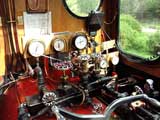
For those on broadband, or faster, internet connections here is a silent video taken on the footplate of Camila. The locomotive was climbing Macarena bank with a seven coach train. Shaun McMahon is at the controls. Note the loco is single manned with all the frequently used controls conveniently grouped together. Also note the use of full regulator with a relatively short cut off. This file is 3.37MB. |
 |
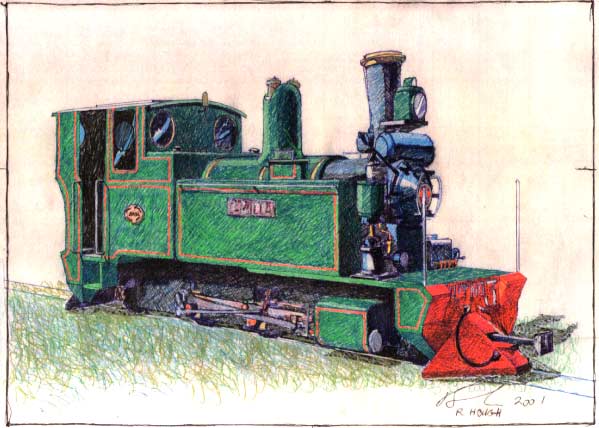 |
An
artists impression of how FCAF No.3 'Camila' may look after the second
stage of modifications are complete. Some changes are now likely in light
of experience with the loco after the first stage was completed. Courtesy
of Shaun McMahon |