Mount
Washington Cog Railway,
New Hampshire, USA
The First Lempor in the USA
In October 2003 the world's first rack & pinion railway - The Mount Washington Cog Railway started work on redraughting their loco fleet, with the design work being carried out by Nigel in the UK.
During this time locomotive No.9 Waumbek became the first of the fleet to receive a Lempor exhaust and thus proved what Nigel had promised he could achieve - a very considerable decrease in fuel consumption brought about by much more complete combustion, leading to far less smoke and an increase in power.
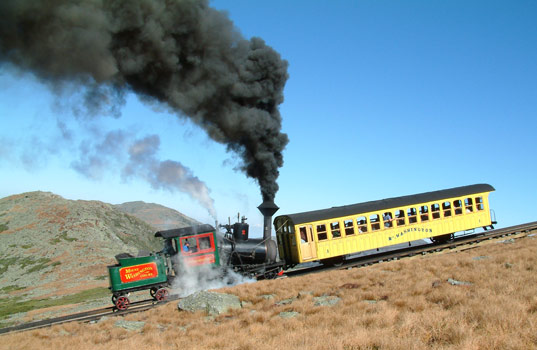
The first few photographs are included to give an idea of the line and its' locomotives, which it has to be said are fairly primitive beasts.
All photos have come via Nigel.
Click to jump down to 2004 work.
No.2 makes a very typically smokey climb. October 12 2003 Courtesy of Nigel Day
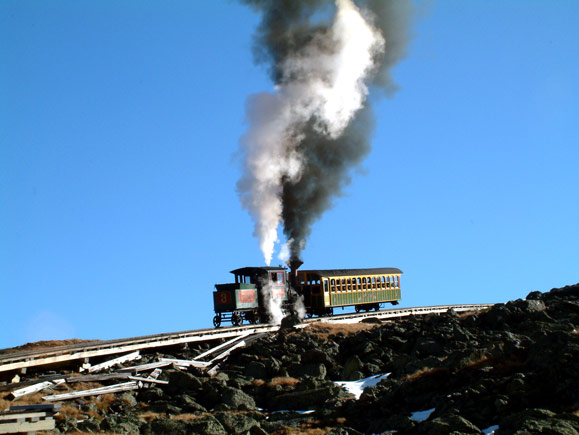
No. 2 heads for the summit. October 12 2003 Courtesy of Nigel Day
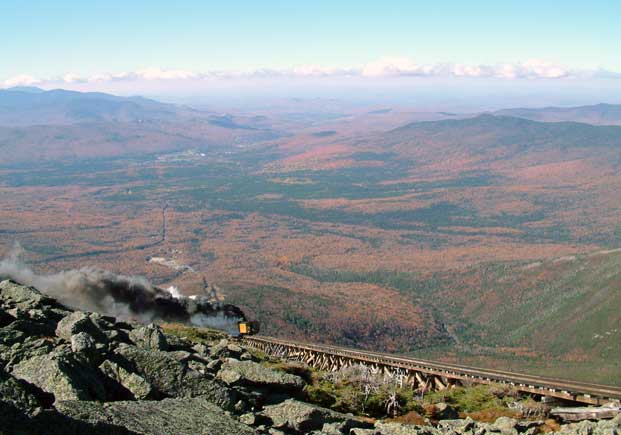
A view over a long wooden trestle with another heavily smoking locomotive heading uphill. October 14 2003 Courtesy of Nigel Day
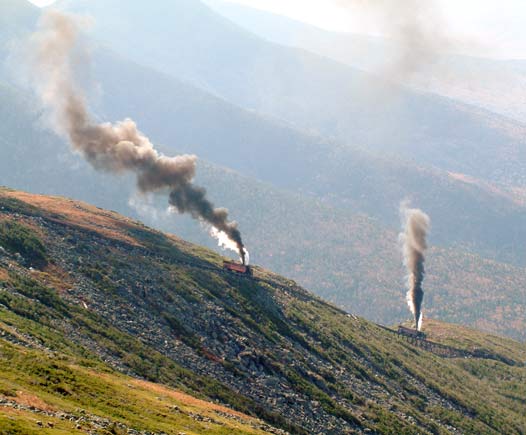
Two trains head uphill. October 12 2003 Courtesy of Nigel Day
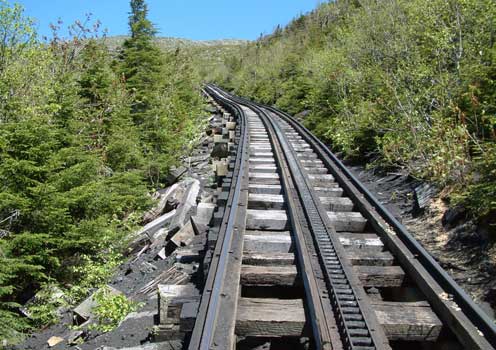
Looking uphill. June 2004 Courtesy of Nigel Day
The First Lempor - Locomotive No.9 Waumbek
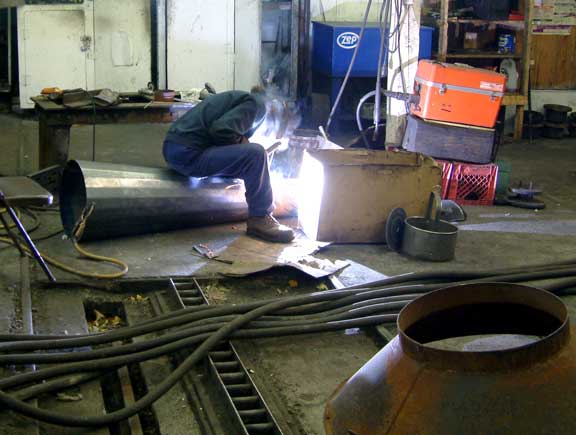
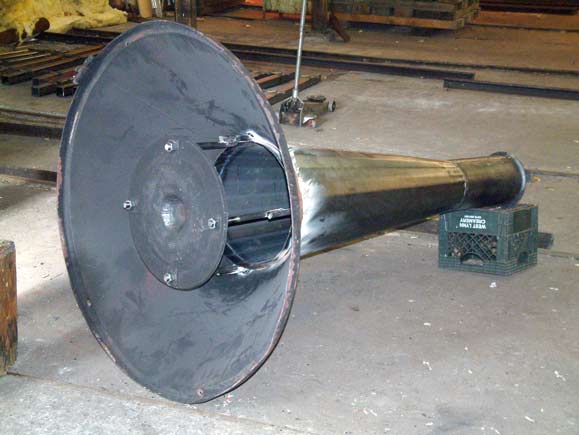
The diffuser, which is being used as a seat, gets welded to the mixing chamber. October 19 2003 Courtesy of Nigel Day
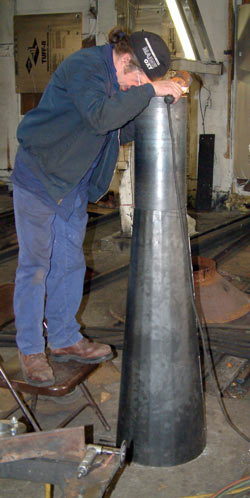 |
The diffuser and mixing chamber. October 19 2003 Courtesy of Nigel Day |
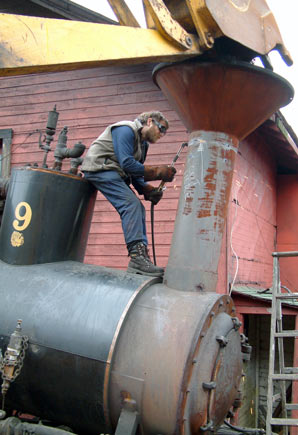 |
Gas-axing
the top section of No.9's chimney for reuse shortly. October 20 2003 Courtesy
of Nigel Day |
 |
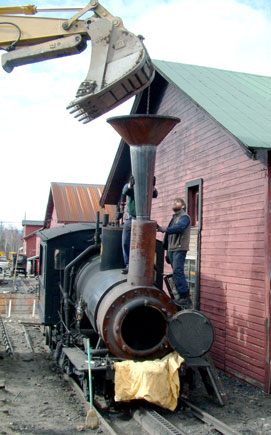 |
The
section cut off the old chimney was welded to the top of the diffuser.
October 21 2003.Courtesy of Nigel Day |
The
new mixing chamber and diffuser, with traditional chimney top, is lowered
in to position on No.9. October 21 2003. Courtesy of Nigel Day |
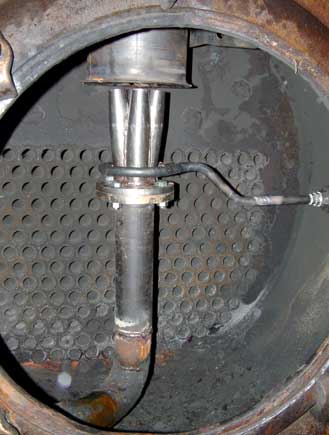 |
Inside
the smokebox the blast pipe was extended, a Lempor nozzle and a much better
blower were installed. The bottom section of the mixing chamber is also
clearly visible. October 22 2003. Courtesy of Nigel Day |
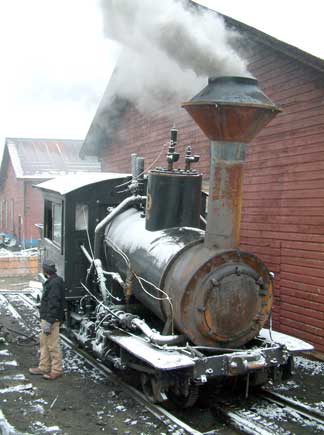 |
October
23 2003 was the first day No.9 Waumbek was steamed with the new exhaust
arrangement. Here the locomotive is warming up for the day after an overnight
snowfall. Courtesy of Nigel Day |
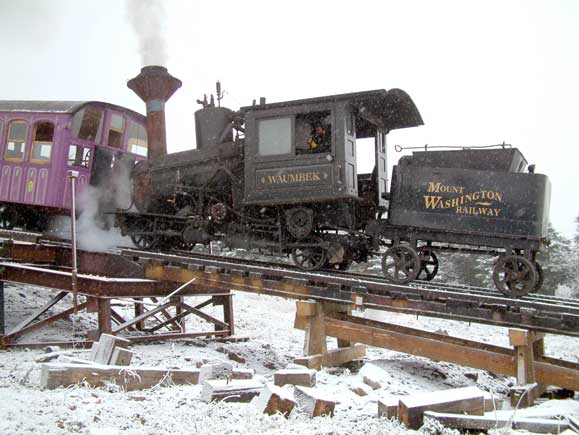
No.9 Waumbek out on the road on test. October 23 2003 Courtesy of Nigel Day
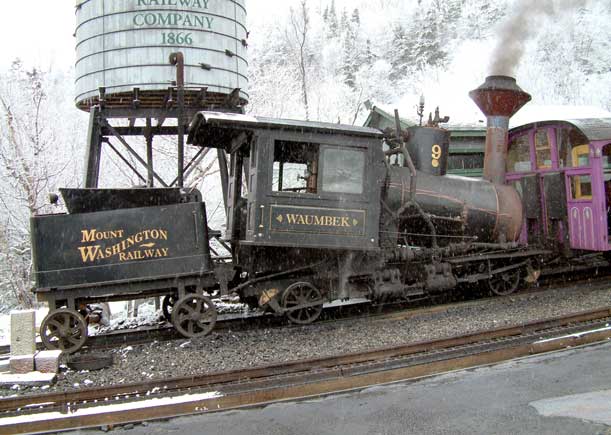
No.9 Waumbek at the base station. October 23 2003 Courtesy of Nigel Day
In mid 2004 more work was undertaken on No.9. With the Lempor performing well, as predicted, further work was undertaken to radically improve the locomotive.
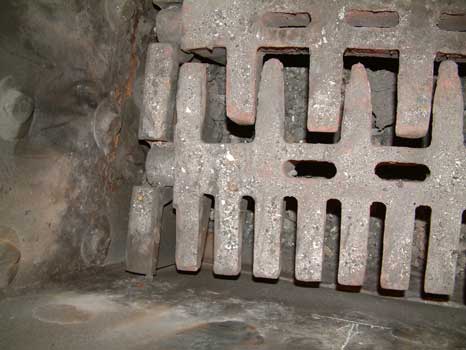
A long term problem with the locos has been tube blockages. Whilst this problem eased after the Lempor was installed things were still not as they should be. Study showed that the firebar spacing too wide leading to a great deal of carry over. So temporary measures were undertaken to reduce the gaps and at the same time the combustion arch was altered to promote better combustion and to help reduce carryover.
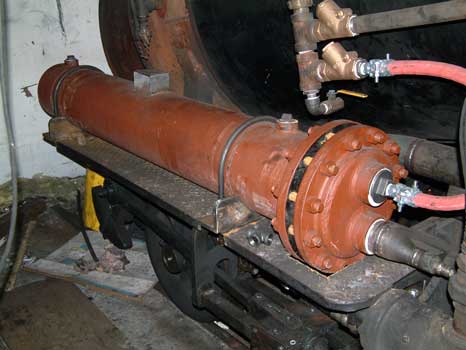
The exhaust steam pipe from the cylinders to the smokebox was rerouted to give a better flow and less pressure drop. It is still far from ideal but such are the restrictions of modifying old locos rather than starting afresh with a blank sheet of paper.
The other major modification made at this time was the fitting of a feedwater heater. Given the very high steam demands from the locos the advantages in efficiency of a feedwater heater are very significant.
And the results so far? A 69% reduction in coal consumption - and this is just the start. More work is planned on No.9 to trial and prove certain features before taking things further.
