08 May - Marseille St. Charles to Lyon Perrache with 241P 17
The day dawned bright and warm in Marseille. With departure north scheduled for 11:30 there was a bit of time to look at Marseille before making our way to Marseille St. Charles station. We were being left to our own devices to get from our hotel to the station - this was fine as the metro station at Estrangin was just a few minutes walk from the hotel. Situated on metro line 1 the route took us to the St. Charles station without needing to change.
Some 'Le Mistral' passengers took advanatge of the morning in Marseille to try to attempt to catch up with certian types of diesels operating in the area. They attempted to catch the 05:18 (no that is not typo) train to Miramis. However they were thwarted by the very best of French traditions - a strike. So they had to be content with an electric hauled train over a different route to Miramas.
Breakfast at our hotel - the Esterel - was not of the highest quality! The croissants were very odd and for those after coffee there was a temperamental machine in the corner. When it did give a drink it would seem the preferred option was to take a sip and not bother with the rest!
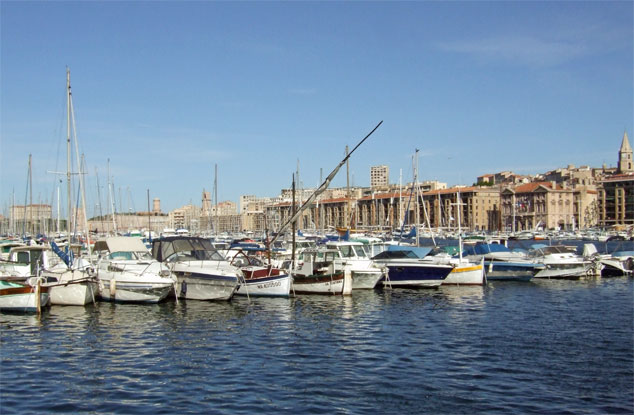
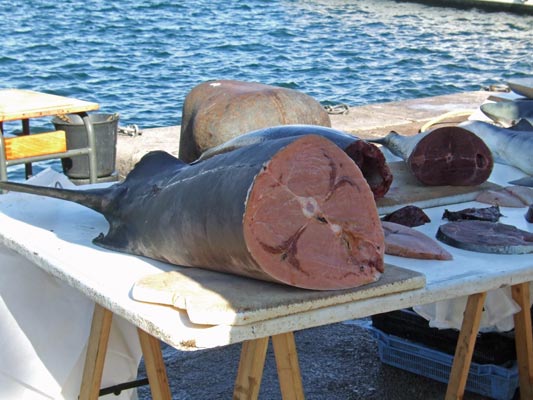
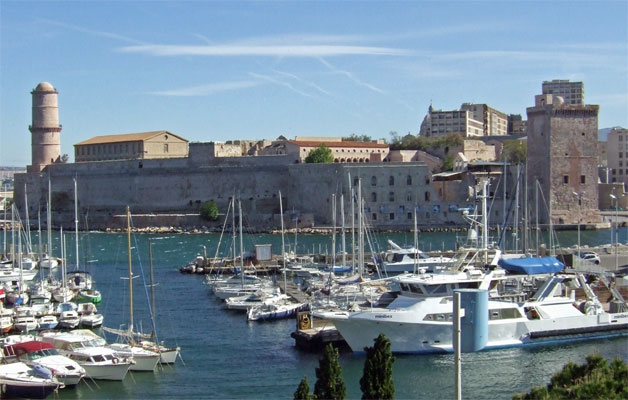
At about 9am we set off down towards the old port to have a look around for an hour or so, with the aim being to see a bit of the Mediterranean coast before getting back on the train. The old port, not surprisingly, is now more of a marina than a working port but when we got there, after about a 10 minute walk from the hotel, a fish market was in progress. Whilst fairly small what was on offer looked to be excellent.
|
Marseille's old port, now more of a marina. |
|
On the Dutch Quay of the old port there was an excellent fish market. |
|
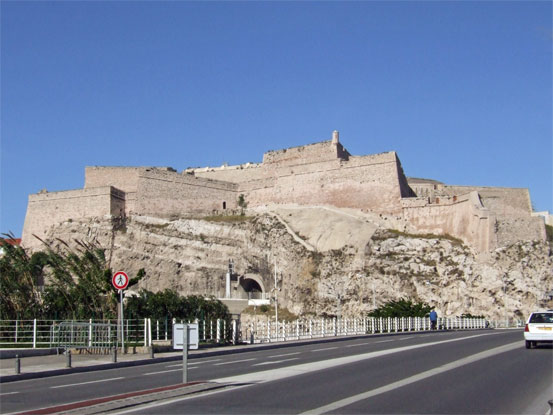
Fort St. Nicholas is on the eastern mouth of the old port's exit into the Mediterranean. |
|
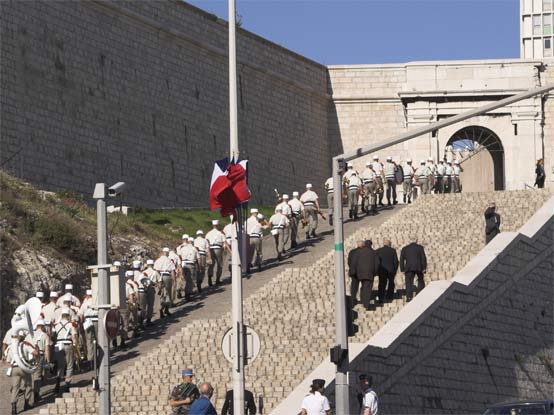
On the steps to the Fort St. Nicholas were a well equipped military band. © Brian Bane |
|
Fort Saint-Jean sits opposite Fort St. Nicholas and somewhat lower down. |
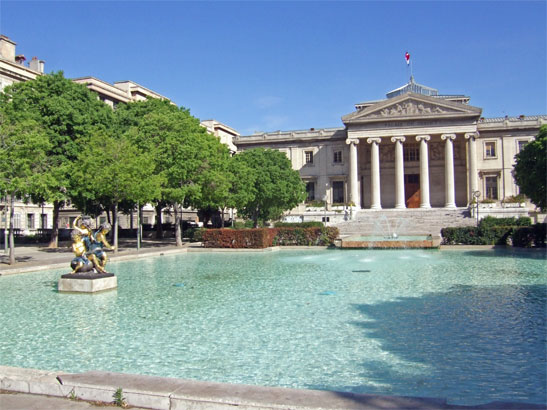
From the old port we opted for the wrong route to see the sea! Heading up the eastern side we never made it as time was too short. However the walk was not wasted as it did allow us a quick look at some of the sites and gave us some good views of the area.
|
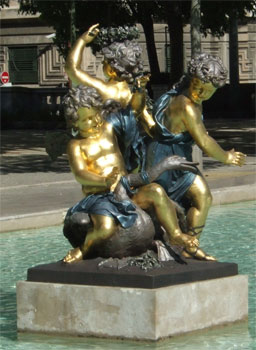
The Palais de Justice at Marseille.
 |
 |
Viewed from the railway station steps this is the Basilica Notre Dame de la Garde. © Brian Bane |
 08 May was a public holiday in France so the metro system was running to a reduced timetable. However we didn't have to wait too long for a train to turn up which took about ten minutes to get us to the SNCF station. Thankfully there were escalators to take us up to the concourse - with the station perched on a hill it would have been meant a huge number of steps to walk up otherwise! 08 May was a public holiday in France so the metro system was running to a reduced timetable. However we didn't have to wait too long for a train to turn up which took about ten minutes to get us to the SNCF station. Thankfully there were escalators to take us up to the concourse - with the station perched on a hill it would have been meant a huge number of steps to walk up otherwise!
Somewhat amazingly the carriages were already in the station and had, for some reason, been turned. So yet again we were fairly close to the engine. However the 241P had yet to appear, but it was not long before we heard the whistle and the loco backed down onto the train. |
 |
Marseille metro map showing which bus connections can be made at the various stations on the two line system. |
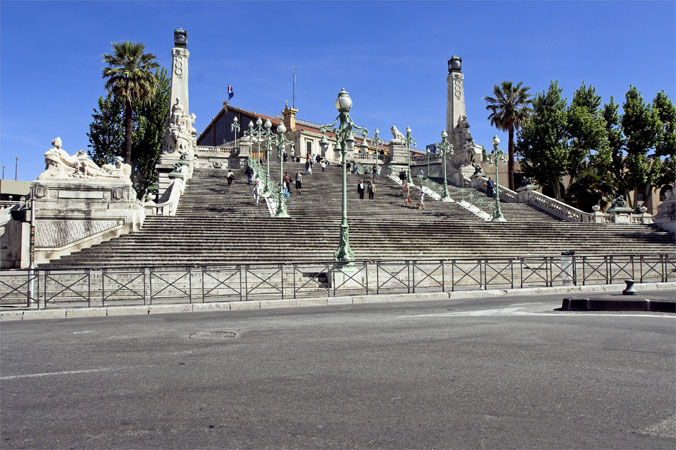 |
Marseille St. Charles station is set on a hill overlooking the harbour. There are quite a few steps up to it! © Brian Bane |
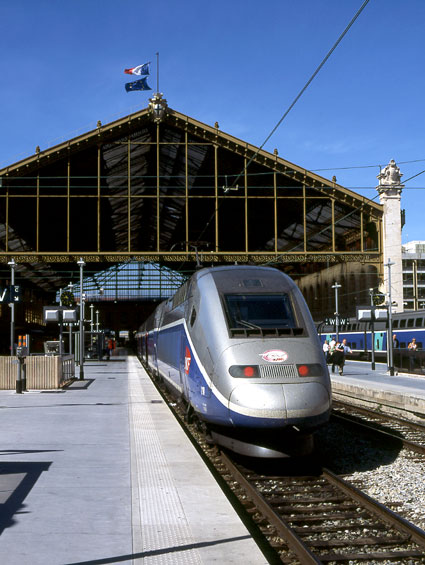 |
A Duplex TGV at Marseille St. Charles station. |
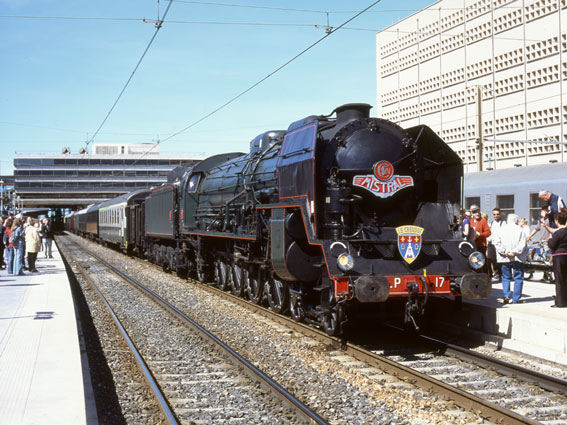 |
Sadly not under the station roof 241P 17 awaits departure time at St. Charles. |
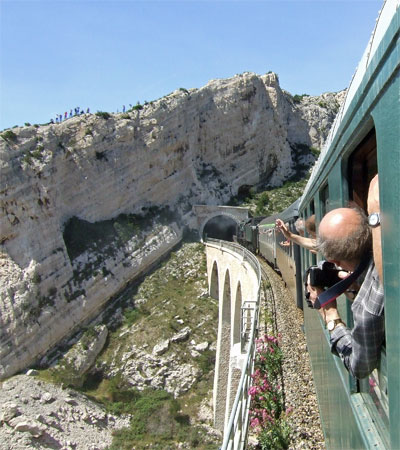
Departure from Marseille was on time and as was common with this loco was accompanied by much use of the whistle. The route to be taken back to Avignon and Lyon was to be almost entirely different to that taken on the way south. At L'Estaque, 8 km from Marseille, we took the unelectrified coast line to Miramas where we picked up the PLM mainline all the way to Lyon. The section of line beyond L'Estaque was almost certainly the very best section of the trip - the scenery was breathtaking with the line cut into the cliffs overlooking the Mediterranean. The weather helped too as it was glorious. As can be imagined there wasn't much room to be found by any of the windows on the seaward side of the train! In addition to many, perhaps hundreds, of photographers perched in precarious and not so precarious positions along the route we were followed by a helicopter, presumably with film crew, for much of this outstanding section of railway.
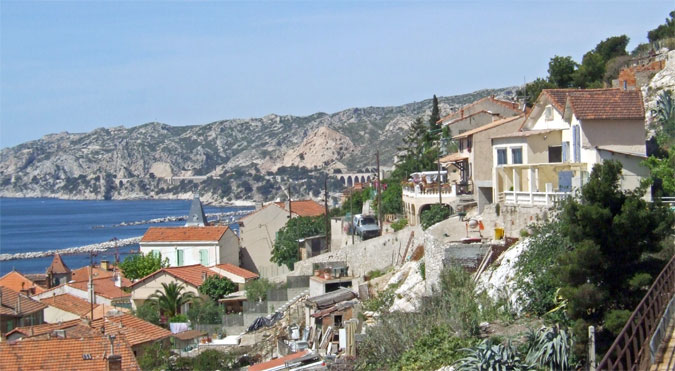 |
The route the line to Miramas takes from the junction at L'Estaque is spectacular. The course can just be made out in this photo - with the line ending up in a tunnel. © Brian Bane |
 |
The coastal route from Marseille to Miramas is not electrified. As can be seen it hugs the cliffs with many tunnels and viaducts in the first few miles out of Marseille. With fantastic views out across the Mediterranean this was probably the scenic highlight of the trip. © Brian Bane |
|
A viaduct followed by a tunnel - typical of the route. All along this section, not surprisingly there were lots of photographers, as here on the cliff top. |
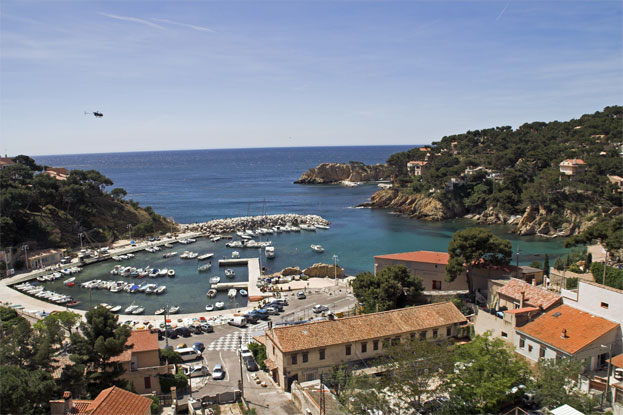 |
On the coastal section to Miramas we were followed most of the way by a film crew in a helicopter. Here they have backed off for a wide shot across the bay but some of the time the helicopter was virtually on top of us. © Brian Bane |
A photostop was arranged on the coastal section at Niolon station. Unfortunately we were prevented from crossing the track here so the hoped for 241P with Mediterranean in the background photo did not materialise. During the stop, when the Le Creusot town shield carried on the front of the loco was removed, the loco was coaled using the grab in the coal wagon behind the loco. Presumably this was the first and only time the loco had been out from under the overhead wires since Chagny so no wonder coal was taken - but this didn't go down too well with some getting photos!
Beyond Niolon the line eventually turned in land and headed for Miramas, passing a great deal of industry on the way, along with what looked like some seriously polluted lakes. At Miramas a stop was booked allowing more photos in the somewhat harsh light. It was then on past the operational hump-yard. It was good to see such a facility in use with a train in the process of be sorted via the hump. The sight of wagons drifting down the yard without brakes suggests SNCF know what they are doing with trains, if not steam hauled ones.
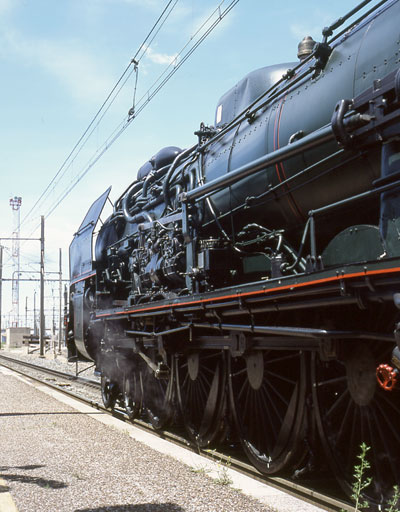
|
The 241Ps are not the prettiest locos around. On the driver's side running plate the ACFI feedwater pump, hot and cold sides, takes up quite a lot of space.
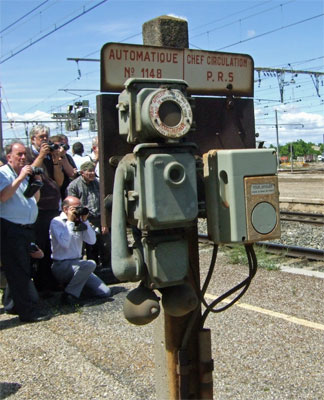
A French railway telephone and English Gricers as Miramas.
|
The route didn't really demand anything of the loco so other than on a few starts the 241P was practically silent again. However the excellent scenery and weather did make up for this. One further stop was made at Arles, 35km before the first water stop of the day at Avignon. There was some confusion at Avignon - we couldn't find the station shops to buy cold drinks and an ice cream, where on earth had it gone? It was as if we were on a different station to the previous evening - but then all became clear! We were sat in the same platform and were facing in the same direction as before. When we arrived from Tournon we had crossed the Rhône to the south of the station then departed for Marseille initially east/north before turning to the south. Today we had arrived from the south and were leaving to the north. So the shops were in the same place after all and we were not on the opposite side of the station as had been supposed!
The train was, almost remarkably, running to more or less to time which was great! Next stop was Montélimar. Here half the town had turned out, or so it seemed. There were people everywhere all very enthusiastic for the train other than the handful of passengers waiting for a normal service train who mainly looked as if they were wondering what all the fuss was about!
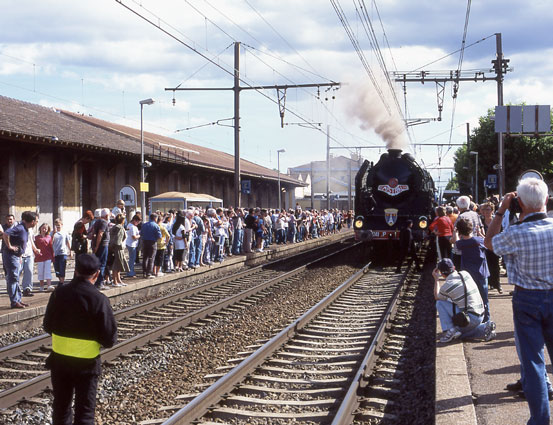 |
Montélimar was booked as a photo stop. However there was little chance of an unrestricted view as half the town had turned out to see the train! |
After Montélimar there was just one more booked stop. This was for water at Valence. Again a sizeable number of locals had turned out. Not for the first time the form seemed to be to get up into the carriages and half a nose about. No doubt this was entirely innocent but with so many valuables on the train eventually doors were locked and tour staff manned the unlocked doors. One day, perhaps, it is to be hoped the interest in the train can be translated into "bums on seats" to help keep French mainline steam alive.
 |
241P 17 at Valence, alongside Poste 1. The live steam pipe to the high pressure cylinder on this side of the loco can clearly be seen running back along the side of the boiler. Other details visible include parts of the ACFI feedwater heating system and bogie brakes. |
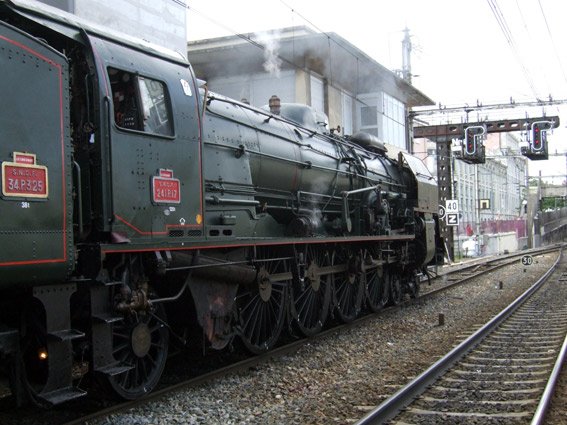 |
Looking ready for the road and almost not like 2007 the 241P stands at Valence. |
 |
The 241P people take a wagon with them which contains coal, a grab to get the coal into the tender and other items such as oil making them about as self-sufficient as it is possible to be. |
|
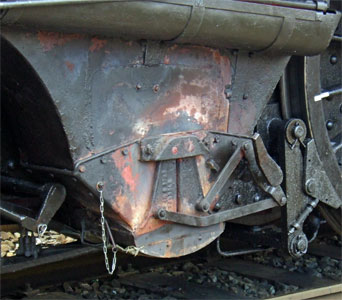
At Valence the ashpan, which had been on fire the previous day, was still looking somewhat scorched. |
As we headed north the weather started to change with a lot of clouds appearing in the sky. By the time Lyon was getting close there were signs it had been raining. In some ways a break from the heat further south was quiet welcome. The train pulled into Lyon Perrache about ten minutes late accompanied by much whistling - this being the end of the 241Ps involvement in the trip. As we came into the station we could hear a lot of noise coming from somewhere - whether it was the effect of the 241Ps whistle or not I don't know but the noise was coming from inside Lyon prison which is alongside the station. I can't imagine there were too many enthusiasts in the prison.
A lot of people, self included, headed straight back to the hotels we had been in previously in readiness for diner, it still be early enough for us to care! However many stayed on the platform and were "crossed" as we walked back towards the station on our way to diner. I assume they has stayed to see the 241P off. Maybe we should have done likewise but food was calling!
However the day ended badly for the 241P and her support crew. The loco was derailed in one of Lyon's yards. I am not sure when the loco was finally allowed to return to Le Creusot. Although there was plenty of equipment available at the yard to re-rail the loco the rumour on the train was that SNCF were insisted on non-destructive testing of the derailed wheels before allowing the loco to run home.
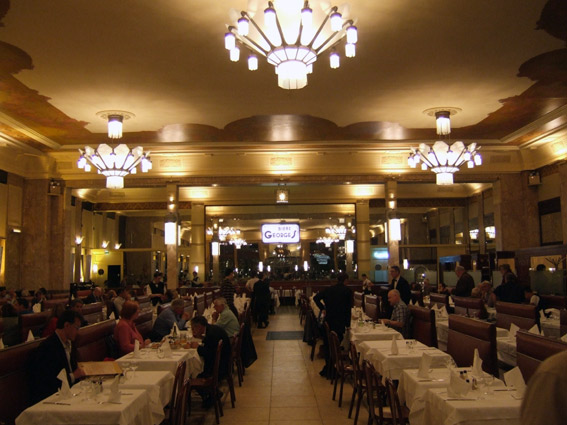 |
For diner we returned to the excellent Brassiere George. |
On to 09 May
Close Window